The 45 Best Sitcoms of the Past 45 Years

One of the most important shows in television history is a series you’ve probably never heard of. Starring real-life couple Mary Kay and Johnny Stearns, Mary Kay and Johnny aired around 300 episodes from late 1947 to Spring 1950, first on the now-defunct DuMont television network, then CBS and NBC. Johnny was a bank employee; Mary Kay his wacky wife; they eventually welcomed a baby, Christopher, the couple’s real son.
Even if the show doesn’t ring a bell, it may still sound familiar. That’s because Mary Kay and Johnny was America’s first televised sitcom.
The “situation comedy” genre has expanded and evolved in the nearly 80 years since that debut, but the basic formula endures: A group comprised of roughly a half dozen people – family, friends, and/or coworkers – congregate in a specific location – a living room or bar, most frequently – and comedic hijinks ensue. Although the setup is little more than a Madlib, there’s room for endless ingenuity within these cramped creative quarters. All you need is a little cleverness and a lot of humor.
With DISH celebrating its 45th Anniversary this year, we thought it would be fun to look back on the 45 best sitcoms our satellites have beamed into homes since the early ‘80s. While the shows themselves might be funny, putting this list together was no joke: We easily could have listed 100 more (this Wikipedia list of sitcoms will cramp your scrolling finger before you even reach the letter “M”). The only rules we made are that the show had to debut on a channel DISH carries – sorry, streamers – and the series had to run for at least five seasons.
Even with these guidelines, the task was harder than Michael Scott restraining himself from whipping out a “that’s what she said” joke. OK, fine, go ahead Michael…
Here’s our list of the 45 Best Sitcoms of the past 45 Years. Not a DISH subscriber? Follow this link to find the best offer and subscribe to DISH today!
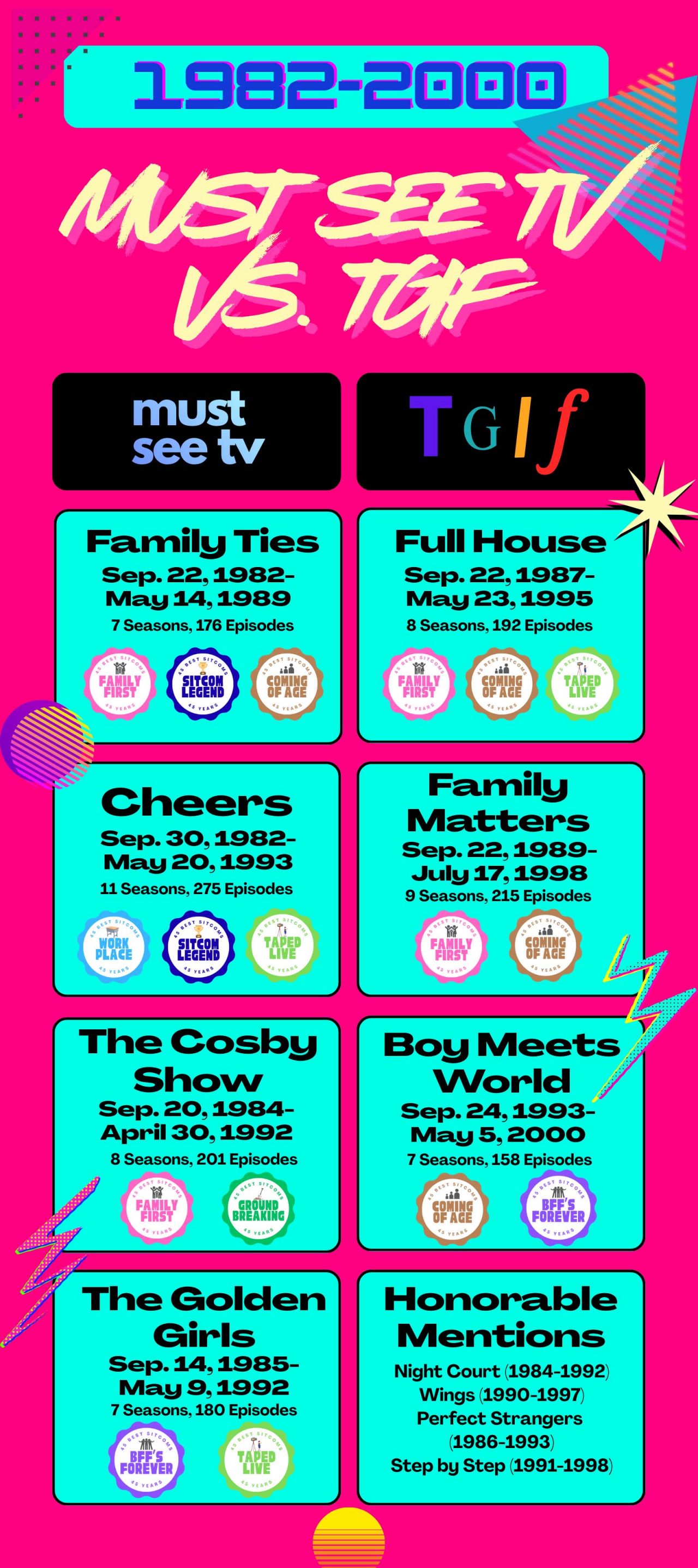
“Must See TV” vs. “TGIF”
While the slogan “Must See TV” now evokes memories of some the best sitcoms of all time, NBC’s Thursday night comedy lineup in the 1980s went by a longer, but deserving, moniker – “The Best Night of Television on Television.” It started with the debut of Family Ties and Cheers in the fall of 1982, shows that launched the careers of sitcom legends Michael J. Fox and Ted Danson, respectively. When The Cosby Show launched in the fall of 1984, NBC officially had a comedy juggernaut on its hands. While the sight of his name might cause us to wince in 2026, Bill Cosby was the biggest TV star of the ‘80s, and by the end of the decade, The Cosby Show had joined All in the Family as the only sitcoms to top the Nielsen ratings for five seasons. NBC’s Thursday night dominance in the ‘80s and ‘90s served as a launchpad for other popular sitcoms, like The Golden Girls, which ran Saturday nights on NBC from 1985 to 1992.
Of course, other networks were paying attention. ABC staked its own claim for comedy dominance on Friday nights with their “TGIF” lineup of the ‘80s and ‘90s. With shows like Webster and Mr. Belvedere paving the way in the mid-80s, “TGIF” officially launched in the fall of 1989 with a lineup that included the corny but endearing classics like Full House and Family Matters. Those shows remained “TGIF” staples throughout the ‘90s, before eventually giving way to more youth-oriented sitcoms like Sabrina the Teenage Witch and Boy Meets World.
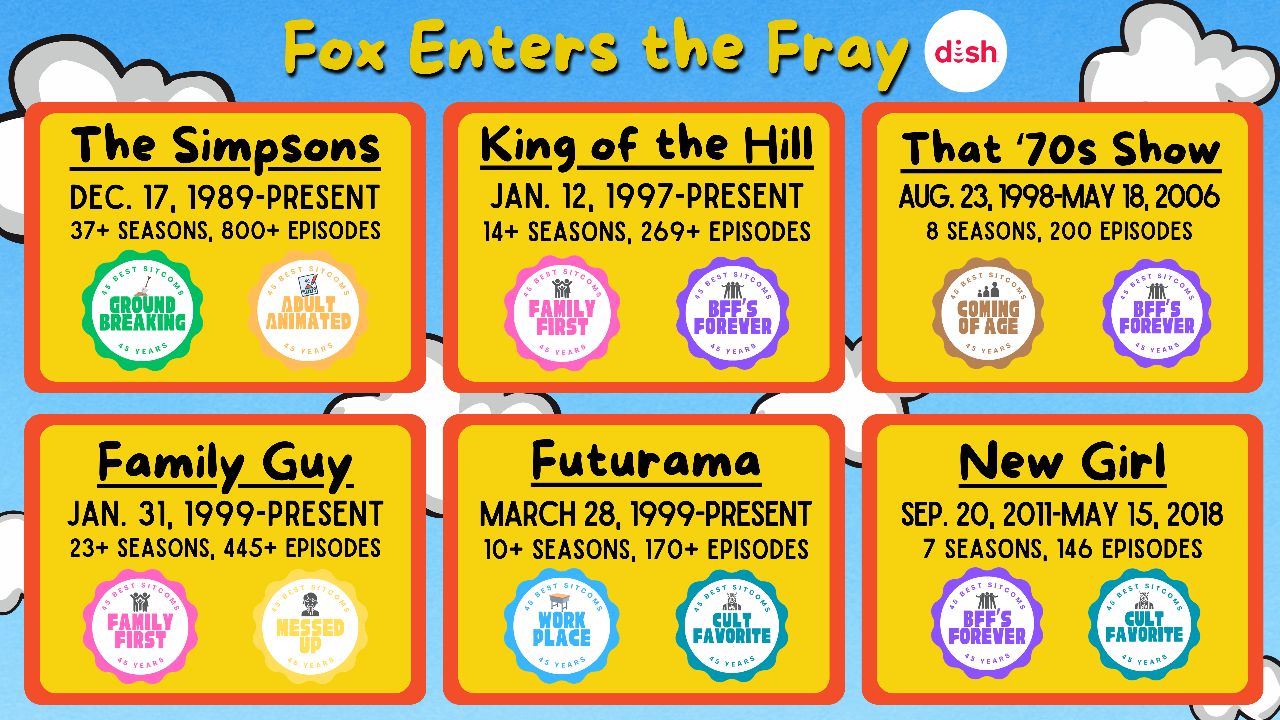
FOX Enters the Fray
Considering what a major media brand FOX is today, it’s hard to believe the network was once a plucky disruptor to the Big Three television networks of ABC, CBS, and NBC. FOX officially launched on Oct. 9, 1986, and early hits like Married…With Children and 21 Jump Street helped it gain a foothold in American homes. But it wasn’t until the launch of The Simpsons in the final days of the ‘80s that FOX had its first breakout hit. There’s little to be said about The Simpsons that hasn’t already been covered in countless books, documentaries, even philosophy courses: At 37 seasons and counting, The Simpsons is the best and most influential TV series of all time, sitcom or otherwise.
As the ‘90s rolled on, FOX debuted a number of other popular animated sitcoms, King of the Hill, Family Guy, and Futurama chief among them. The latter two shows have gone on to have successful second runs, with Comedy Central then Hulu resurrecting Futurama, and FOX bringing back Family Guy after reruns on Adult Swim helped establish their edgy brand of animated humor. Even today, FOX is still synonymous with “animation domination,” but they’ve had a number of live-action sitcom successes as well. That ‘70s Show introduced the world to stars like Ashton Kutcher, Mila Kunis, Topher Grace, and Wilmer Valderrama, while single-camera sitcoms like New Girl and Brooklyn Nine-Nine have become rewatchable staples on streaming.
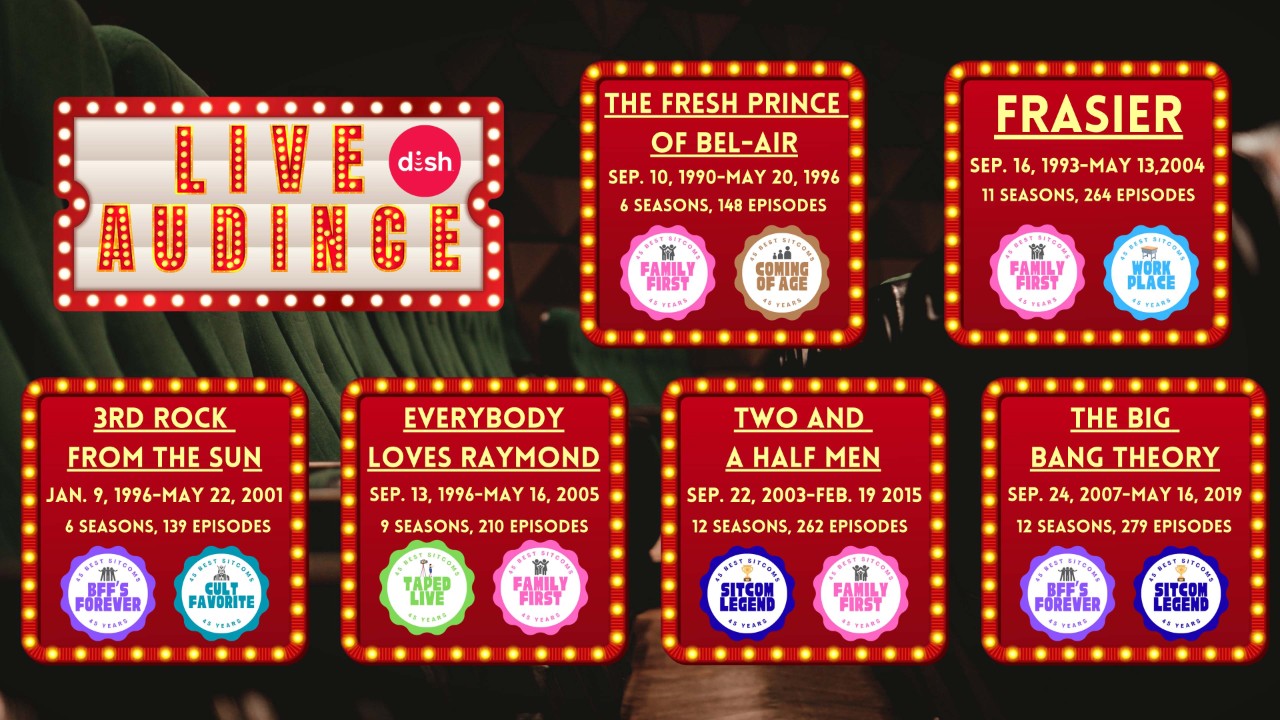
Live and Direct
Unlike TV dramas, many of the most popular sitcoms were – cue announcer voice – taped in front of a live studio audience. In this respect, many sitcoms are almost closer to theatre than television, with the audience’s authentic response informing the performances in real time. Rewatching classic NBC sitcoms like Frasier, 3rd Rock From the Sun, and The Fresh Prince of Bel-Air – where the audience was treated to a live set from DJ Jazzy Jeff on Friday tapings – you can practically see the crowd doubling over in laughter while registering the reactions from the actors on set.
Even though fewer and fewer sitcoms (and shows in general) are relying on studio audiences, the format has nevertheless persisted. Smash CBS sitcoms like Everybody Loves Raymond, Two and a Half Men, and The Big Bang Theory all benefitted tremendously from having a crowd of 200-300 people laughing along, with the latter series often undergoing immediate rewrites if a joke or scene wasn’t landing. Despite distilling episodes down to a tight 22-ish minutes, these tapings weren’t necessarily that brisk; with rewrites and reshoots, each episode often took many hours to complete, necessitating producers to “sweeten” the laughter from the audience in post-production.
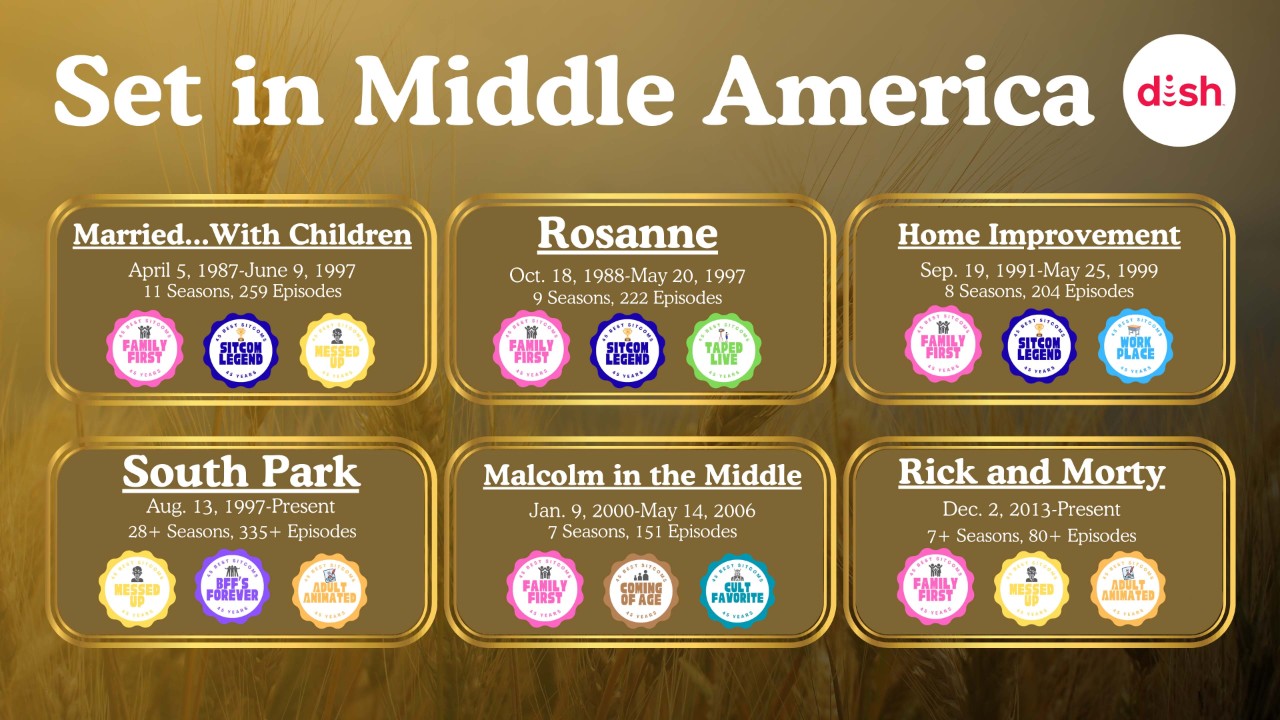
Malcolm (and More) in Middle America
While New York City (or a soundstage in LA pretending to be NYC) has been home to countless classic sitcoms, many others have attempted to capture the comedic sensibilities of those of us living in so-called “flyover country.” Debuting in 1988, Rosanne brought the small joys and everyday struggles of working class Americans into the spotlight, and continued to do so with its seven-season revival/spin-off The Connors. FOX’s Married…With Children, set in the outskirts of Chicago, was even more crass in its portrayal of a shoe salesman with an unhappy family life. And despite focusing on the star of a TV show, the Detroit-set Home Improvement captured the zeitgeist of those of us who can’t afford to pay others to fix things around the house, a wave that star Tim Allen has continued to surf in shows like Last Man Standing and Shifting Gears.
Depending on your point of view, it’s easy to see middle America-set shows like Malcolm in the Middle as cynical celebrations of family dysfunction produced by coastal elites. But like the ambiguously middle-American setting of The Simpsons, these shows are more generously seen as reflecting the relatable ups-and-downs of regular people who love each other in spite of their flaws. Unless we’re talking about animated satires like South Park and Rick and Morty. Those shows use a rural mountain community and non-descript suburban setting, respectively, as platforms for humor that’s scatological, absurd, imaginative, cutting, and above all, hilarious.

Friends' Zone
A group of friends hanging out will lead to jokes. It’s generally true in real life; in sitcoms, it’s an immutable law. Even in family sitcoms, there’s a wacky neighbor or two who pops in periodically to get razzed and/or dish out burns. But some of the most successful sitcoms of all time have focused on friends, including NBC’s smash ‘“Must See TV” sitcoms Seinfeld, Will & Grace, and, uh, Friends. As different as those shows are in comedic tone, they all focus on a group of New Yorkers laughing at and with each other, topped by a sprinkle (or more) of will they/won’t they sexual tension.
In fact, a group of twenty-something friends hanging out and navigating life in the city is perhaps the most malleable trope in all of sitcoms. How I Met Your Mother – incidentally, not filmed in front of a studio audience, despite the laugh track – followed a group of five New Yorkers along the comedic journey spelled out in the show’s title. Contrast that with It’s Always Sunny in Philadelphia, another show that started out as “young people in a pub” but has continued the story well into middle-age, with its characters steadfastly refusing to mature. The Comedy Central cult classic Broad City borrowed a lot from Always Sunny’s edgy sensibility, but applied it to a pair of broke young women in NYC. And FX’s brilliant mockumentary What We Do in the Shadows centered on a quartet of ageless vampires living in Staten Island and their hilarious attempts to engage with the modern world. While all of these shows share superficial similarities, each has their own distinct tone and comedic sensibilities.
Work Retreat
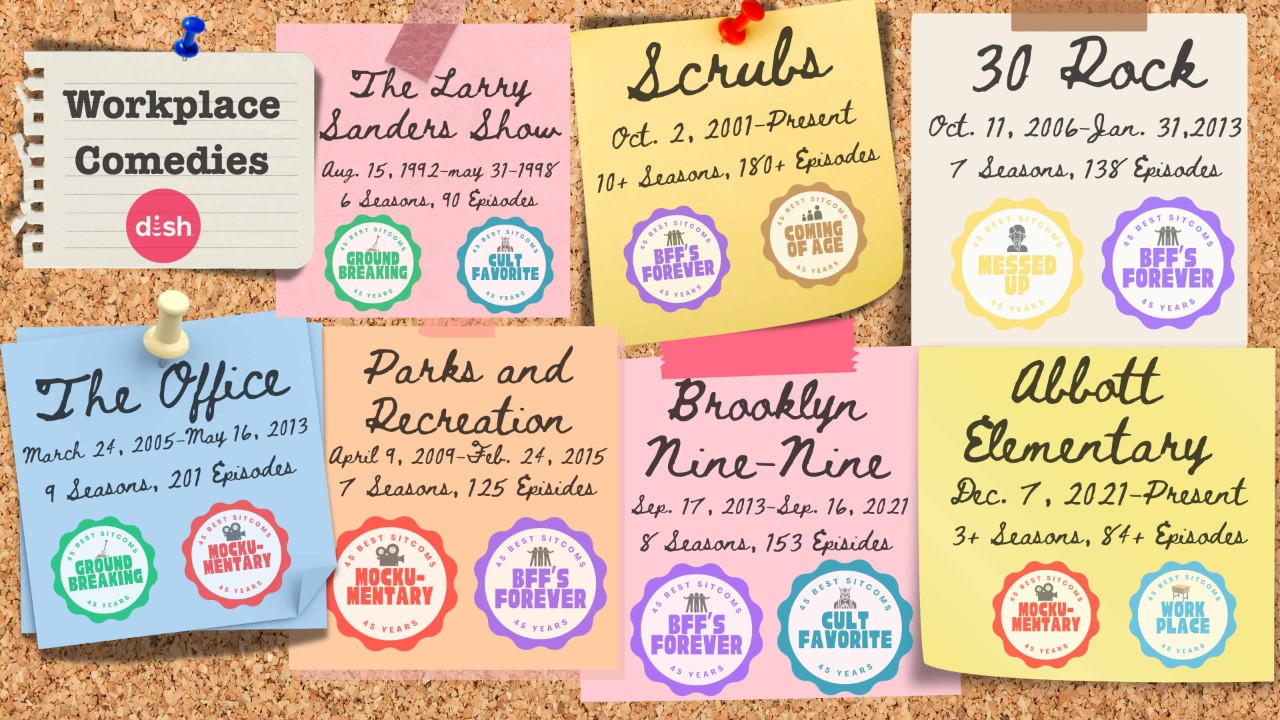
Family, friends, and work – these are the cornerstones that make up most of our lives. Naturally, sitcoms have followed suit, and our 9-to-5 lives have proven to be just as rewarding for comedy as they are for our wallets. The head honcho of the workplace comedy is, of course, The Office, one of the funniest shows of all time, if you can stomach the cringe. And while an incompetent boss in a drab office was ripe for mockery, plenty of other shows have mined humor out of unlikely vocations. Scrubs – which just launched its revival on ABC – managed to transplant plenty of humor into a hospital setting, and Abbott Elementary – the best sitcom of the 2020’s – has earned high marks while cribbing notes from The Office. Most unlikely of all is Brooklyn Nine-Nine, a series that ranks among the funniest shows of the last decade despite being set in a police precinct.
Of course, the set of a television show is also a workplace, and sitcom writers have been turning their gaze inward going all the way back to I Love Lucy. But in the modern era, two TV shows about TV shows stand head and shoulders above the rest. HBO’s paradigm-shifting The Larry Sanders Show featured former talk show host Gary Shandling playing a fictional talk show host interviewing actual celebrities playing fictionalized versions of themselves. And NBC’s sharp, joke-dense 30 Rock centered around an SNL-type sketch comedy show on NBC, giving the show an equal opportunity to skewer actors, writers, and their corporate overlords.

Single (Camera) and Ready to Mingle
To the corporate executives that 30 Rock so expertly roasted, the biggest appeal of sitcoms filmed in front of a live studio audience is their relatively low-budgets. And while single-camera sitcoms have a history dating all the way back to The Adventures of Ozzie and Harriet, the single-camera format – deceptively named, but essentially shows that eschew the three-cameras and a stage method of sitcoms filmed in front of studio audiences – began to really take flight when TV budgets increased early in the 21st century. Beginning in 2000, Curb Your Enthusiasm transmuted the most antisocial elements of Seinfeld into the more mature sensibilities of HBO audiences, while star-making cult sensation Arrested Development took plot-heavy stupid-smart humor to hilarious new frontiers.
By ditching the soundstage, sitcoms were also able to reflect the real world in ways that make full use of how the dictionary defines “funny.” HBO’s Veep now feels eerily prescient in its foretelling of Washington’s vain, clueless leadership, while black·ish touched on racial issues that would only come to the forefront of the culture late in the series run. We might be exaggerating a touch by suggesting that Schitt’s Creek makes deep and meaningful points about Canada’s class struggle, but in a decade where The Bear can take home a record number of Emmy awards in the comedy categories, it’s clear that the line between laughing and crying is blurier than ever.